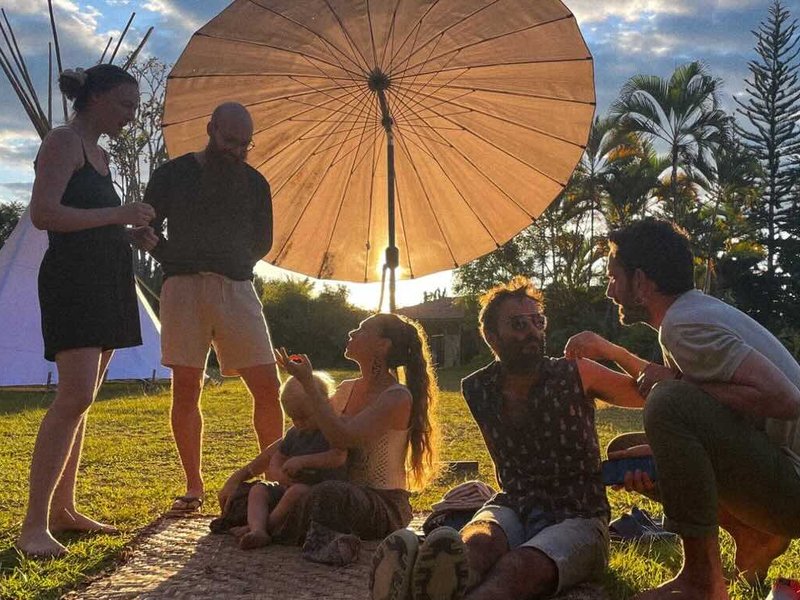
Family coliving is what happens when a small group of families choose to live together, in one place, for a stretch of time, on purpose. Usually a month, sometimes two or three, occasionally longer. The families have their own private rooms or cabins. They share meals, common spaces, and a daily rhythm that someone (the host, the facilitator, or the families together) has thought carefully about.
That's the short answer. Most parents we talk to actually want a longer one, because the term has been getting tossed around lately and the picture in their head is fuzzy. So here's the longer answer, with the bits the brochures usually leave out.
It's not coworking with kids attached
The first confusion we hear: "Oh, it's coworking but for families." It's not, really. Coworking is a workspace you pay for. Family coliving is a way of living for a defined period, where work happens to be one part of the day, alongside meals together, kids learning together, and the kind of slow conversation that only happens when you stop performing being together and just are.
The work piece is real. Most parents in our cohorts are full-time remote workers, and the days are structured to protect that. But the work is not the point. The point is everything else around it.
It's not a hotel, and it's not a retreat
Hotels are transactional. You pay, they serve. Retreats are time-bounded immersions, often around a theme (yoga, breathwork, business). Family coliving is closer to a temporary village. You're a participant, not a guest. Some weeks you cook a meal for everyone. Sometimes you watch someone else's kid for an hour while their parent takes a call. You hold a small piece of the rhythm.
That participation is the difference, and it's also the part that takes some getting used to. The families who thrive in coliving are the ones who arrive willing to share, not just consume. We talk about this on the Aterra cohort page and the Casa Sumapaz page: shared space asks something of you. The trade is that you get something back that no resort can sell.
What's actually included in a typical month
The shape varies by host and location, but most family coliving setups include some version of:
- Private accommodation for your family, plus access to shared lounges, kitchens, and outdoor spaces.
- A daily rhythm, usually with a morning anchor (group breakfast, opening circle), a parent work block, and an afternoon community window.
- A kids program, run by an educator on site. At Cohli we call this Cohli Kids: project-based, place-based learning, designed for mixed ages 2 through 12.
- Shared meals, often three a day, often using local ingredients. The kitchen is usually a real social center, not just a fueling station.
- A facilitator or host who holds the social and emotional container. Helps newcomers integrate, names tensions early, runs the rituals that keep the group cohered.
- Occasional excursions and skill-shares: a parent teaches photography, a local guide leads a hike, a chef shows how to make the regional bread. Nothing required, but everyone usually shows up to most of them.
What it costs (the short version)
Honest range for a thoughtfully-run, family-included month: roughly two to six thousand dollars per family, depending on location, included meals, accommodation type, and length of stay. That covers your private space, most or all of your meals, the kids program, and the cost of running the community on your behalf.
That sounds like a lot until you do the comparison. A month of Airbnb plus groceries plus tutoring plus social organizing plus the airport-to-airport logistics for a family of four often costs more than a Cohli-style cohort, and lands you with significantly less community at the end. We wrote a separate piece breaking the math down properly: what family coliving actually costs (and what's included).
Who it tends to fit
The families who thrive in coliving have a few things in common. They're not full-time digital nomads (most of ours have a home base they return to). They're remote-friendly for at least part of their work. They're parents who have started to feel that the standard "school week, weekend trip, repeat" rhythm isn't quite enough for what they want their kids' childhood to feel like.
They're also, almost universally, people who like other people. Coliving is not a fit for families who want their travel to feel private and uninterrupted. The whole point is the interruption: the unexpected dinner conversation, the kid who befriends yours by week two, the parent who turns out to share your obscure professional interest.
What it's not (worth saying out loud)
Coliving is not a vacation. You will work. Your kids will have meltdowns. Some weeks the rhythm clicks; some weeks it takes a while to find. The first few days especially are an adjustment, and the last few days are emotional in a way nobody warns you about.
It's also not a school replacement. Cohli Kids is rich, place-based learning, but it's a few weeks long. If your family is fully unschooling or worldschooling year-round, a cohort is one stop on a longer journey. If your family is in school the rest of the year, a coliving cohort is a temporary departure from that, not a substitute.
The shortest definition we've landed on, after running three of these: family coliving is a temporary village built on purpose, for families who want their kids to grow up around other adults who care. Everything else (the meals, the work setup, the curriculum, the location) is logistics in service of that.
Is this the same thing as worldschooling?
Related, but not identical. Worldschooling is an educational philosophy: the idea that the world itself, encountered through travel, is the curriculum. A family can worldschool full-time, year-round, without ever doing a coliving stay. And a family can do family coliving without identifying as worldschoolers (most of ours don't, full-time).
The two overlap when families bring worldschooling values into a coliving cohort, which most do. We wrote about this distinction in detail: worldschooling explained: how kids learn when school isn't the building.
Where to look if you're still curious
If you've read this far and the picture is starting to feel real, the next step depends on where you are. If you're researching: the self-test article in this journal lays out eight honest questions worth asking before you apply anywhere. If you're closer to ready: the cohort pages on cohli.com show what specific cohorts look like, with dates and pricing. And if you'd like to be looped in when we open new ones, the Village Post newsletter is where we send updates.
We've been running family coliving cohorts since 2024. We are still learning. We get things wrong sometimes. But the families who come keep telling us, in different ways, that the village they remember is the one they wish their kids could grow up inside more often. That's the thing this whole experiment is in service of.